An RS-485 Transceiver Module is a compact communication device designed to interface a microcontroller (e.g., Arduino, ESP32, GLYPH, STM32) for long-distance, reliable serial communication. Unlike standard UART (TTL), RS-485 uses differential signaling to resist electrical noise, making it suitable for industrial environments. In this document, you will understand how to interface the RS-485 Transceiver with GLYPH, enabling robust data transfer for applications such as Modbus networking, industrial automation, and remote sensor monitoring.

Pin Configuration


Key Features

  • Differential signaling for high noise immunity
  • Long-distance communication (up to ~1200 meters)
  • Supports multi-device (multi-drop) network
  • Half-duplex communication support
  • UART to RS-485 signal conversion
  • Low power operation

Applications

  • Industrial automation systems
  • Modbus communication networks
  • Smart energy meters
  • Building automation & HVAC control
  • PLC and SCADA systems
  • Long-distance sensor networks

Step 1: Hardware Required

  1. Glyph Board (e.g., Glyph ESP32-C3)
  2. G-MOD RS-485 Transceiver Module

Step 2: Circuit Diagram
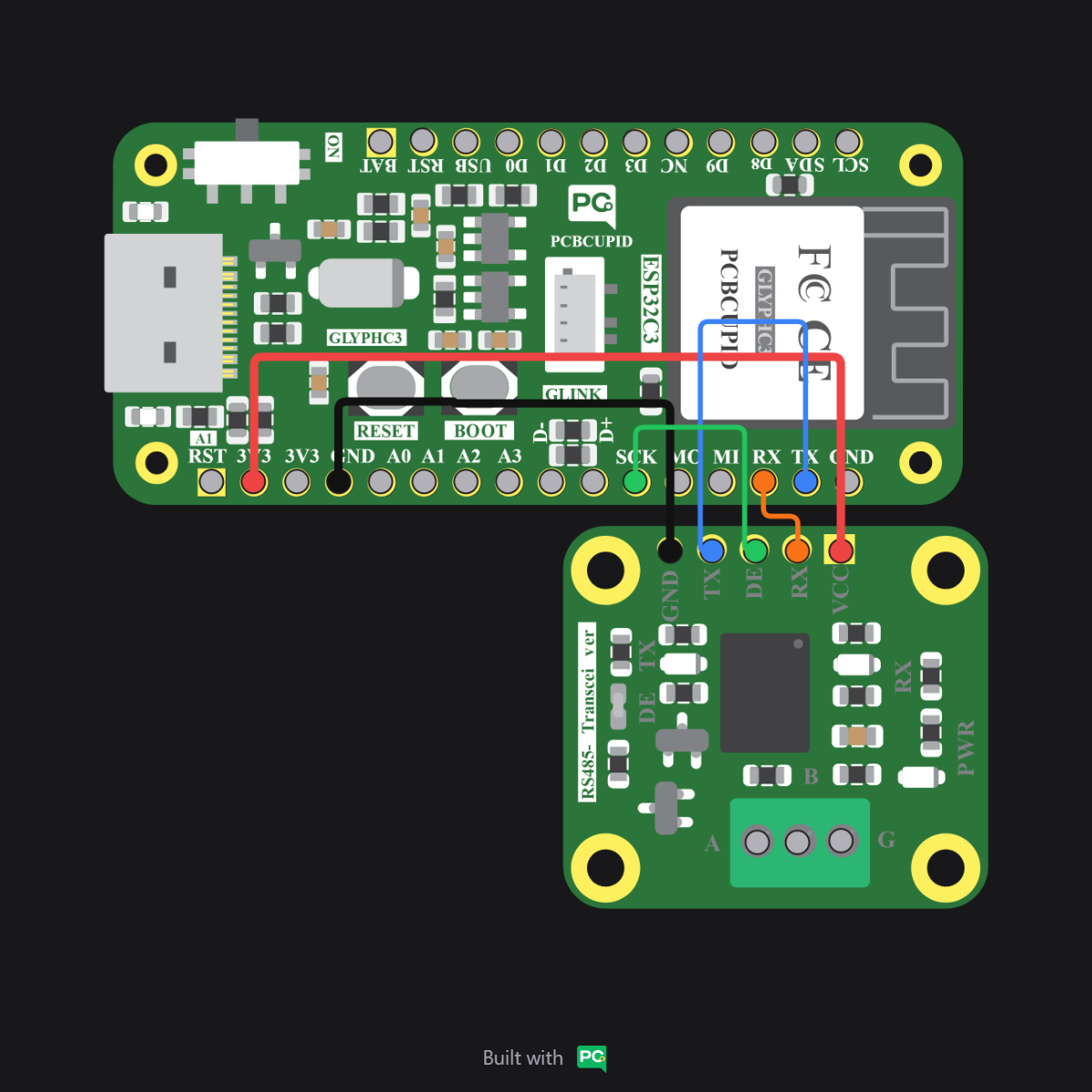
RS-485 Circuit Diagram