> ## Documentation Index
> Fetch the complete documentation index at: https://learn.pcbcupid.com/llms.txt
> Use this file to discover all available pages before exploring further.
> Overview of the Glyph Mini RP2040 development board: a compact and high-performance microcontroller powered by the Raspberry Pi RP2040 chip.
# Overview
export const ShopHeader = ({title, url}) => ;
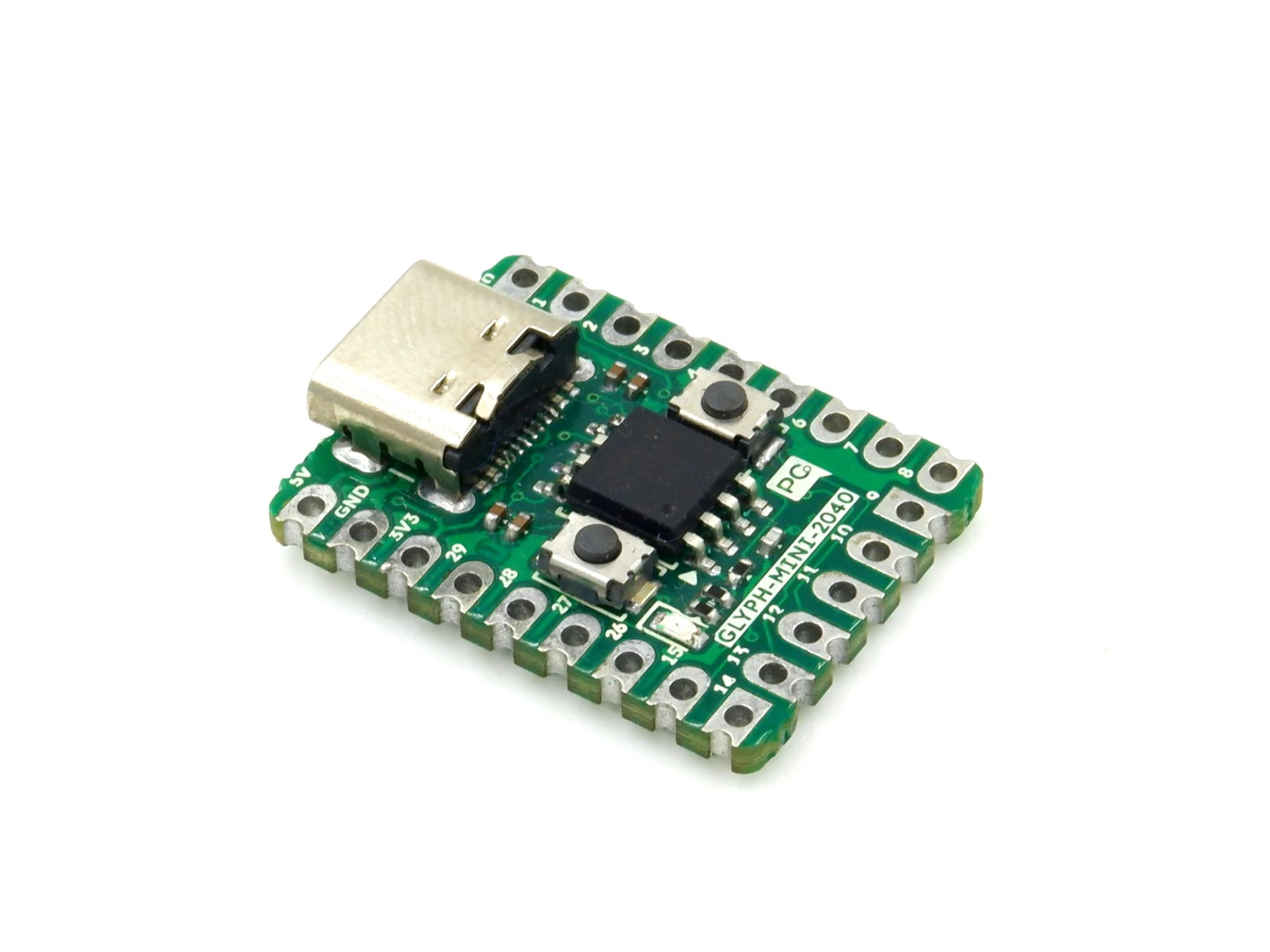 Introducing the Glyph Mini RP2040, a compact and high-performance microcontroller development board powered by the powerful RP2040 chip. Ideal for IoT projects, robotics, sensors, and advanced embedded systems, the Glyph Mini offers flexibility, speed, and modern connectivity—making it a perfect platform for innovation and rapid prototyping.
### Features
* **Dimensions**: Measures 18mm x 23.5mm without headers soldered in
* **Processor**: Raspberry Pi RP2040 32-bit dual-core ARM Cortex-M0+ processor running up to 133 MHz @ 3.3V logic and power
* **RAM**: 264 KB on-chip SRAM
* **Flash Memory**: 8 MB on-board SPI Flash
* **GPIO**: 20 multi-function GPIO pins
All the important peripherals, labeled for easy access.
### Power Management
* **USB Type-C Connector** for power, programming, and serial debugging
* **LDO Regulator** with up to 800mA peak output current
This board lacks on-board battery protection, charging circuitry, or hot-swap logic. Battery connection requires external protection/switching.
### Additional Features
* **On-board Status LED** (Connected to GPIO16)
* **BOOT and RESET buttons** for easy firmware access and programming
### Bootloader and Programming
The Glyph Mini RP2040 comes with a built-in USB UF2 bootloader, making firmware uploads simple and hassle-free. For first-time use, hold down the BOOT button while connecting the board to your computer via USB (or press RESET while holding BOOT). It will appear as a removable mass storage device, allowing you to drag and drop your `.uf2` firmware file.
### Connectivity
The RP2040 is a powerful microcontroller ideal for high-speed local processing and I/O. For wireless applications, it easily supports external modules such as:
* **Bluetooth**: HC-05 / HC-06
* **Wi-Fi**: ESP8266 / ESP32 (AT commands or co-processor)
* **Long Range**: nRF24L01, LoRa, or XBee
With multiple SPI, I2C, and UART interfaces, integrating these modules is straightforward and efficient.
### Development Support
The Glyph Mini RP2040 is supported by a robust ecosystem of development environments:
* **MicroPython** (Official RP2040 support)
* **CircuitPython** (Official Adafruit support)
* **Arduino IDE**
* **C/C++ (Pico SDK)** (Full support via VSCode)
With extensive library support, strong community backing, and rich documentation, getting started with the Glyph Mini RP2040 is simple and efficient for both beginners and advanced developers.
### Memory and Storage
The RP2040 features 264 KB of on-chip SRAM for fast data processing. In addition, it includes 8 MB of on-board SPI Flash shared between code, file storage (LittleFS), and application data.
### RP2040 Chip Features
* **Dual-core ARM Cortex-M0+**: Deterministic and high-performance processing.
* **Up to 133 MHz**: Flexible PLL allows for overclocking if needed.
* **Programmable I/O (PIO)**: Dedicated state machines for custom peripheral protocol handling.
* **Low Power Modes**: Capable of achieving sleep currents around 2 mA.
You can read more about it in [RP2040 DATASHEET](https://files.waveshare.com/upload/f/fd/Rp2040_datasheet.pdf)
Introducing the Glyph Mini RP2040, a compact and high-performance microcontroller development board powered by the powerful RP2040 chip. Ideal for IoT projects, robotics, sensors, and advanced embedded systems, the Glyph Mini offers flexibility, speed, and modern connectivity—making it a perfect platform for innovation and rapid prototyping.
### Features
* **Dimensions**: Measures 18mm x 23.5mm without headers soldered in
* **Processor**: Raspberry Pi RP2040 32-bit dual-core ARM Cortex-M0+ processor running up to 133 MHz @ 3.3V logic and power
* **RAM**: 264 KB on-chip SRAM
* **Flash Memory**: 8 MB on-board SPI Flash
* **GPIO**: 20 multi-function GPIO pins
All the important peripherals, labeled for easy access.
### Power Management
* **USB Type-C Connector** for power, programming, and serial debugging
* **LDO Regulator** with up to 800mA peak output current
This board lacks on-board battery protection, charging circuitry, or hot-swap logic. Battery connection requires external protection/switching.
### Additional Features
* **On-board Status LED** (Connected to GPIO16)
* **BOOT and RESET buttons** for easy firmware access and programming
### Bootloader and Programming
The Glyph Mini RP2040 comes with a built-in USB UF2 bootloader, making firmware uploads simple and hassle-free. For first-time use, hold down the BOOT button while connecting the board to your computer via USB (or press RESET while holding BOOT). It will appear as a removable mass storage device, allowing you to drag and drop your `.uf2` firmware file.
### Connectivity
The RP2040 is a powerful microcontroller ideal for high-speed local processing and I/O. For wireless applications, it easily supports external modules such as:
* **Bluetooth**: HC-05 / HC-06
* **Wi-Fi**: ESP8266 / ESP32 (AT commands or co-processor)
* **Long Range**: nRF24L01, LoRa, or XBee
With multiple SPI, I2C, and UART interfaces, integrating these modules is straightforward and efficient.
### Development Support
The Glyph Mini RP2040 is supported by a robust ecosystem of development environments:
* **MicroPython** (Official RP2040 support)
* **CircuitPython** (Official Adafruit support)
* **Arduino IDE**
* **C/C++ (Pico SDK)** (Full support via VSCode)
With extensive library support, strong community backing, and rich documentation, getting started with the Glyph Mini RP2040 is simple and efficient for both beginners and advanced developers.
### Memory and Storage
The RP2040 features 264 KB of on-chip SRAM for fast data processing. In addition, it includes 8 MB of on-board SPI Flash shared between code, file storage (LittleFS), and application data.
### RP2040 Chip Features
* **Dual-core ARM Cortex-M0+**: Deterministic and high-performance processing.
* **Up to 133 MHz**: Flexible PLL allows for overclocking if needed.
* **Programmable I/O (PIO)**: Dedicated state machines for custom peripheral protocol handling.
* **Low Power Modes**: Capable of achieving sleep currents around 2 mA.
You can read more about it in [RP2040 DATASHEET](https://files.waveshare.com/upload/f/fd/Rp2040_datasheet.pdf)